Georgia logs 5.5 million tourist visits as political standoff enters second year
Tbilisi sees record tourism growth and 7.5% GDP expansion even as protests mark two years since the contested elections.
By Giulia Gallagher ·
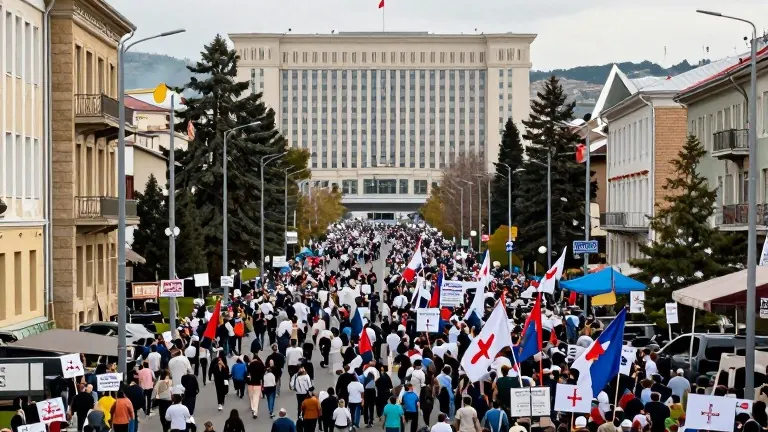
Two years have passed since the contested parliamentary elections in Georgia sparked a nationwide protest movement.
Protesters continue to gather every weekend in Tbilisi’s Avlabari Square. The Saturday March leads crowds toward parliament to challenge the government of Prime Minister Irakli Kobakhidze. The demonstrations target Georgian Dream, the ruling party that has held power since 2012 and suspended EU accession talks.
The country recorded over 5.5 million international tourist visits in 2025. This figure represents an 8.4% increase compared to 2024. It is also nearly ten times the number of visitors who arrived two decades ago. The Georgian National Tourism Administration released the data recently. Tourists come from Europe, the Middle East, and Russia, drawn to historic sites and post-Soviet urban landscapes.
Russian presence has grown since the full-scale invasion of Ukraine began in 2022. Tens of thousands of Russian citizens moved to Georgia, bringing capital and opening businesses. Their spending has pressured the property market as they purchase homes across the country. This influx has fueled local discontent among Georgians who remember the 2008 war with Russia and view Moscow as an occupying power in Abkhazia and South Ossetia.
Georgia’s economy expanded by 7.5% in 2025, marking five consecutive years of growth. Despite this, the nation faces high unemployment, low wages, and widespread poverty in rural areas. The country, which has a population under 4 million, remains economically dependent on trade, remittances, and energy imports from Russia. Diplomatic relations were severed after the 2008 conflict, yet economic ties persist.
Relations with the European Union have deteriorated recently. Brussels has criticized the Georgian government for issues related to the rule of law and political repression. The political crisis that began with the October 2024 elections continues to shape domestic policy. The government announced it would not open EU negotiations before the end of 2028. The Rustaveli theatre in Tbilisi, renovated by billionaire Bidzina Ivanishvili, stands as a symbol of the current political era. Ivanishvili founded Georgian Dream in 2012 and served as prime minister from 2012 to 2013.
Source: The Guardian