Midterm 2026: The Narrow Margin and 46 Battlegrounds Defining House Control
With a three-seat gap separating the parties, voters in 46 contested districts and seven states with new maps will determine the balance of power in the House.
By John Wisniewski ·
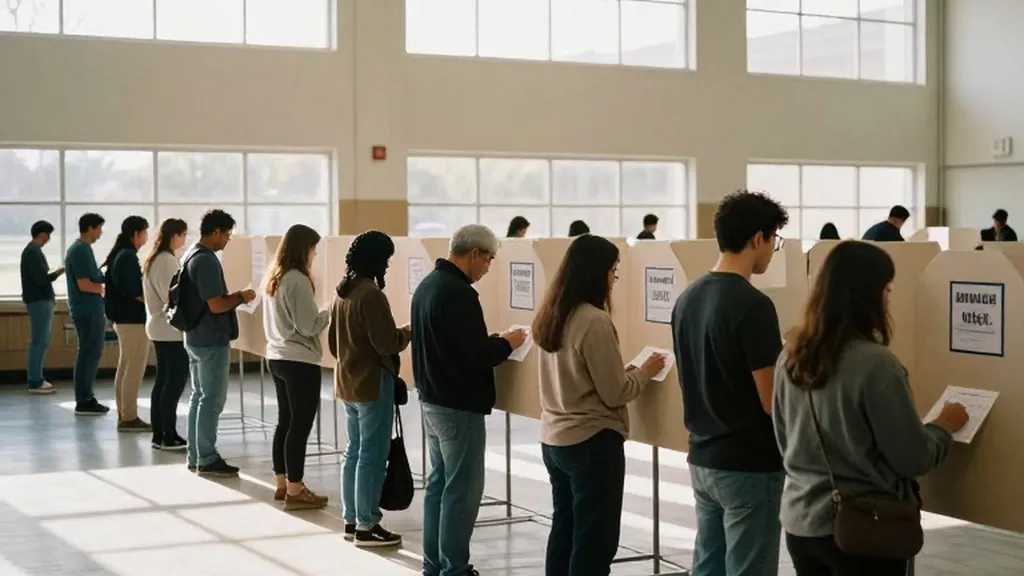
The United States is deciding the control of the House of Representatives on Tuesday, November 3, 2026, in a midterm election that occurs halfway through President Donald Trump's second term. All 435 seats in the lower chamber are up for grabs, making this a full reset of the legislative map. According to Ballotpedia, the current composition sees Republicans holding 218 seats and Democrats holding 214, with one independent and some vacancies remaining. This narrow split creates a scenario where the outcome of a handful of districts will dictate which party holds the gavel for the final two years of the administration.
For Democrats to secure a majority, they require a net gain of three districts. Conversely, Republicans can afford to lose no more than two seats to maintain control. This mathematical tightness has turned the House race into a marathon of close contests rather than a series of clear partisan sweeps. The Associated Press notes that the election is being framed as a referendum on the president's performance, with voters grappling with high prices and an unpopular war with Iran. The stakes are high for both parties, as losing control of either chamber could trigger investigations and potential impeachment proceedings, according to political analysts cited by the AP.
Ballotpedia has identified 46 battleground districts in this cycle, a list that includes 25 seats currently held by Democrats and 21 held by Republicans. These districts are the primary focus of campaign spending and ground operations. The complexity is heightened by the fact that 21 of the Democratic-held districts voted for Trump in the 2024 presidential election, while nine Republican-held districts voted for Kamala Harris. These cross-partisan voting patterns suggest that local dynamics and specific candidate choices are influencing decisions more than traditional party loyalty in these specific congressional races.
Another significant factor shaping the House race is the implementation of new congressional maps in seven states. Following mid-decade redistricting, California, Florida, Missouri, North Carolina, Tennessee, and Texas are using new boundaries for their House seats. Ohio is also utilizing a new map for this election. The Associated Press notes that while Republicans attempted to use redistricting to beat the historical midterm pattern where a president's party loses seats, the effectiveness of these new lines remains to be seen. Some new districts in Florida and other states may not vote as originally predicted by the parties that drew them.
Turnout is a critical variable in this tight race. More than 57 million people had already cast their ballots as of Monday, surpassing the early voting totals from four years ago in many closely watched states. RNC Chairman Joe Gruters stated that everything depends on turnout, asserting that if their voters show up, they will win. In contrast, DCCC Chair Rep. Suzan DelBene emphasized that the American people are angry and want change. The Associated Press describes the mood among Democrats as cautiously optimistic, while Republicans are bracing for the possibility of losing the House while fighting to hold the Senate.
The financial aspect of the race has been unprecedented, with the 2026 elections likely becoming the most expensive in history. Republican committees have outraised and outspent their Democratic counterparts, aided by Trump-affiliated groups and Elon Musk. However, at the candidate level, Democrats have outraised their opponents. An analysis of AdImpact data by the AP shows that 88.1 percent of Republican general election TV ad spending went to states and districts that Trump won in 2024. This targeted spending reflects a strategy to consolidate support in areas where the president has a strong base, while Democrats focus on competitive districts where voter sentiment is shifting.
Voter sentiment is split along clear economic and political lines. AP-NORC polling indicates that 35 percent of U.S. adults approve of Trump's job performance, while only 25 percent approve of his handling of the economy. About seven in 10 respondents say the country is heading in the wrong direction. On the ground, voters express these sentiments directly. Mark Barker of Palm Beach Gardens, Florida, told the AP that he has been following Trump and thinks he is doing an awesome job. James Moore, a librarian in Raleigh, North Carolina, offered a different view, stating that he is paying more in taxes and for healthcare, and feels the strain in every aspect of his life.
The administration's involvement in the election process has also been a point of contention. Trump has continued to make claims about voting fraud, including that noncitizens vote in large numbers. His administration has sued in Alaska and California, and the Justice Department has threatened to prosecute local election officials. A federal judge temporarily barred the administration from carrying out a plan to prevent noncitizen voting, while another judge ordered them to stop demanding that California segregate ballots from people on lists of suspected noncitizens. These legal moves have added a layer of complexity to the administration of the election, with critics arguing it risks disenfranchising eligible voters and infringing on state authority.
The House race is not isolated from other national contests. Voters are also deciding the fates of 35 Senate seats and 36 governorships. The outcome in the House will likely influence the tone of the administration's final two years. If Democrats win control, House Democratic Leader Hakeem Jeffries would become the first Black speaker, bringing with him a 100-day agenda focused on the cost of living and oversight. A strong showing for Democrats could also boost potential 2028 candidates such as Gavin Newsom, JB Pritzker, and Pete Buttigieg, while complicating the path for Vice President JD Vance.