
Francis Halzen Wins 2026 Nobel Prize for IceCube Neutrino Discovery
The award recognizes the detection of high-energy neutrinos from beyond the Milky Way, a capability enabled by a cubic kilometer of Antarctic ice.
By John Wisniewski ·
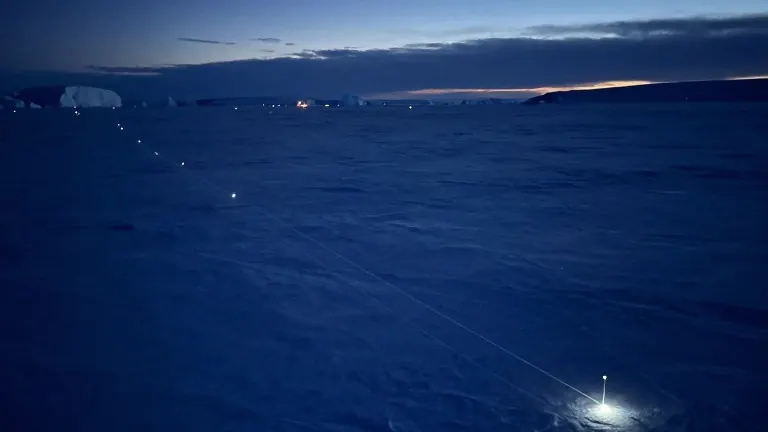
The Nobel Prize committee honored Francis Halzen of the University of Wisconsin-Madison on October 6 for his work with the IceCube Neutrino Observatory. The citation specifically acknowledges his decisive contributions to the detection of high-energy neutrinos of astrophysical origin. This recognition follows a history of Nobel awards in neutrino research, including prizes given in 2002 for cosmic neutrinos from the sun and in 2015 for neutrino oscillations.
Neutrinos are elementary particles that interact only through weak nuclear forces and gravity, ignoring the strong force and electromagnetism. Physicist Wolfgang Pauli hypothesized their existence in the 1930s to solve a problem in beta decay. In that process, unstable atoms emit electrons with varying energy levels, which appeared to violate the conservation of energy. Pauli proposed a neutral particle to carry the missing energy, a theory that has since been confirmed through the observation of beta-minus and beta-plus decays.
The challenge in studying these particles lies in their lack of interaction. To detect them, instruments must be massive. The IceCube observatory occupies one cubic kilometer of Antarctic ice. This scale allows the detector to capture the rare Cherenkov flashes produced when neutrinos interact with the ice. The system can distinguish between electron, muon, and tau neutrinos, the three known flavors of these particles.
Andrew Mattson, a physics PhD student at Johns Hopkins, explained that neutrinos can switch flavors as they travel. Earlier solar neutrino experiments failed to account for this oscillation, leading to measurement discrepancies. IceCube’s ability to detect all three flavors resolved these issues and opened a new field of neutrino astronomy. Mattson noted that the observatory measured neutrinos originating from outside the solar system and even from outside the galaxy.
The ability to trace the path of these particles allows scientists to point telescopes at specific regions of space. This technique helps identify sources such as black holes, supernovae, and quasars. Mattson stated that neutrinos provide a clearer representation of distant objects than photons because they are less likely to be interfered with during transit. IceCube has already used this method to identify high-energy neutrino sources in active galaxies.
The next step for the field is the development of IceCube Gen2. Mattson indicated that this proposed upgrade would expand the detector volume from one cubic kilometer to eight cubic kilometers. The expansion aims to increase the sensitivity of the observatory and allow for deeper probing of the universe’s nature. The project represents a continuation of the work that earned Halzen this year's prize.
The Nobel committee’s decision underscores the importance of detecting particles that are otherwise nearly invisible. By building larger and more sensitive detectors, scientists can map cosmic events that light alone cannot reveal. The recognition of Halzen marks the latest chapter in a decades-long effort to understand the fundamental particles that make up the universe.
Source: The Johns Hopkins News-Letter